
RMI = S + I + C + R + SF + E + SC + CS
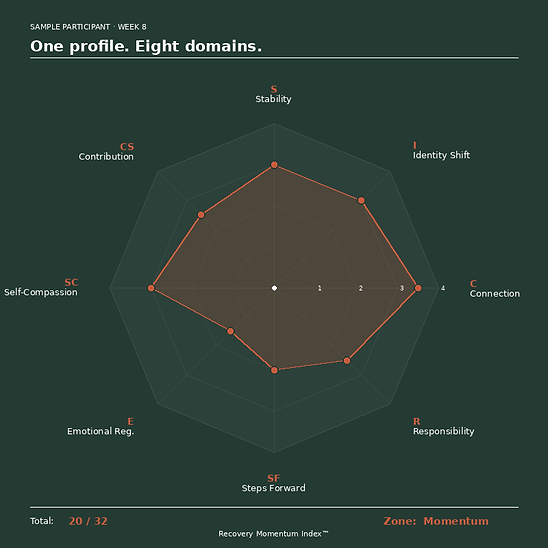
A structured framework that measures the eight areas research says actually predict long-term recovery, not just whether someone stayed clean.
The Problem
Most programs are measuring
the wrong things.
Without RMI
With RMI
✗ Pass/fail drug tests
✗ No early warning system
✗ Gut-feel coaching
→ Weekly domain scores
→ Lowest domain flags risk first
→ Evidence-anchored sessions
Sobriety checks. Attendance sheets. Rule compliance. These matter, but research shows they're not enough to predict who stays in recovery long-term.
✗ Staff score inconsistently
✗ Thin funder evidence
→ Calibrated shared language
→ Trajectory data by domain
✗ Shame cycle invisible
→ SC domain tracks it weekly
The Framework
Eight domains. One score
that means something.
Each domain is anchored in peer-reviewed research and scored 0–4 every week, for a total Recovery Momentum score out of 32.
S · Stability
Stability
Recovery structure, routine, honesty, and safety. The floor everything else is built on.
/Recovery Capital Theory
I · Identity Shift
Identity Shift
Moving from an addiction identity toward recovery ownership and transformation.
/SIMOR · Best et al., 2016
C · Connection
Connection
Healthy relationships, community belonging. Recovery doesn't happen alone.
/Social Recovery Capital
R · Responsability
Respomsability
Accountability, follow-through, ownership of choices. The shift from managed to self-directed.
/Miller et al., 2019
SF · Steps Forward
Steps Forward
Active goals, future planning, transition readiness. Are they building, or just waiting?
/Witkiewitz & Marlatt, 2004
E · Emotional Regulation
Emotional Regulation
Coping skills, stress management, resilience. The #1 relapse predictor, now measurable.
/NIDA relapse research
SC · Self Compassion
Self Compassion
Movement from shame and self-punishment toward self-kindness, healing, and self-care.
/Neff, 2003 · Neff & Germer, 2013
C · Contribution
Contribution & Service
Investing in peers, community, and family beyond the self. Giving back to the people in their lives.
/Zemore & Kaskutas, 2004
SC and CS are unique to the RMI™, measured by no other recovery framework
The Research
Eight domains. One score
that means something.
4X
Recovery capital is among the strongest predictors of long-term recovery maintenance.
White & Cloud, 2008
76%
Difficulty managing negative emotions is among the most common relapse triggers.
Koob & Volkow, NIDA, 2016
2.3X
Self-directed responsibility predicts
higher program-completion rates.
Miller, Forcehimes & Zweben, 2019
68%
Recovery identity is one of the most consistent predictors of sustained abstinence.
Best et al. (SIMOR), 2016
58%
Active goal pursuit is a significant protective factor against relapse.
Witkiewitz & Marlatt, 2004
4
All eight domains map onto SAMHSA's four recovery dimensions: health, home, purpose, community.
SAMHSA ROSC, 2012
ⓘ Important: The Recovery Momentum Index™ is a coaching and measurement framework, not a diagnostic tool or medical device. It is intended to support, not replace, clinical judgment, medical care, or licensed treatment. Domain scores and "relapse risk" indicators are structured observations for coaching purposes only and should not be used as the sole basis for clinical decisions.